How To Make A Whatsapp Group Interesting
The Psychology of the Silent Thread: Why WhatsApp Groups Die
We’ve all seen it happen.
Contents!
- The Psychology of the Silent Thread: Why WhatsApp Groups Die
- Why WhatsApp Group Engagement Fades
- 1. Give the Group a Personality
- Make the Group Picture Part of the Fun
- Use the Description Properly
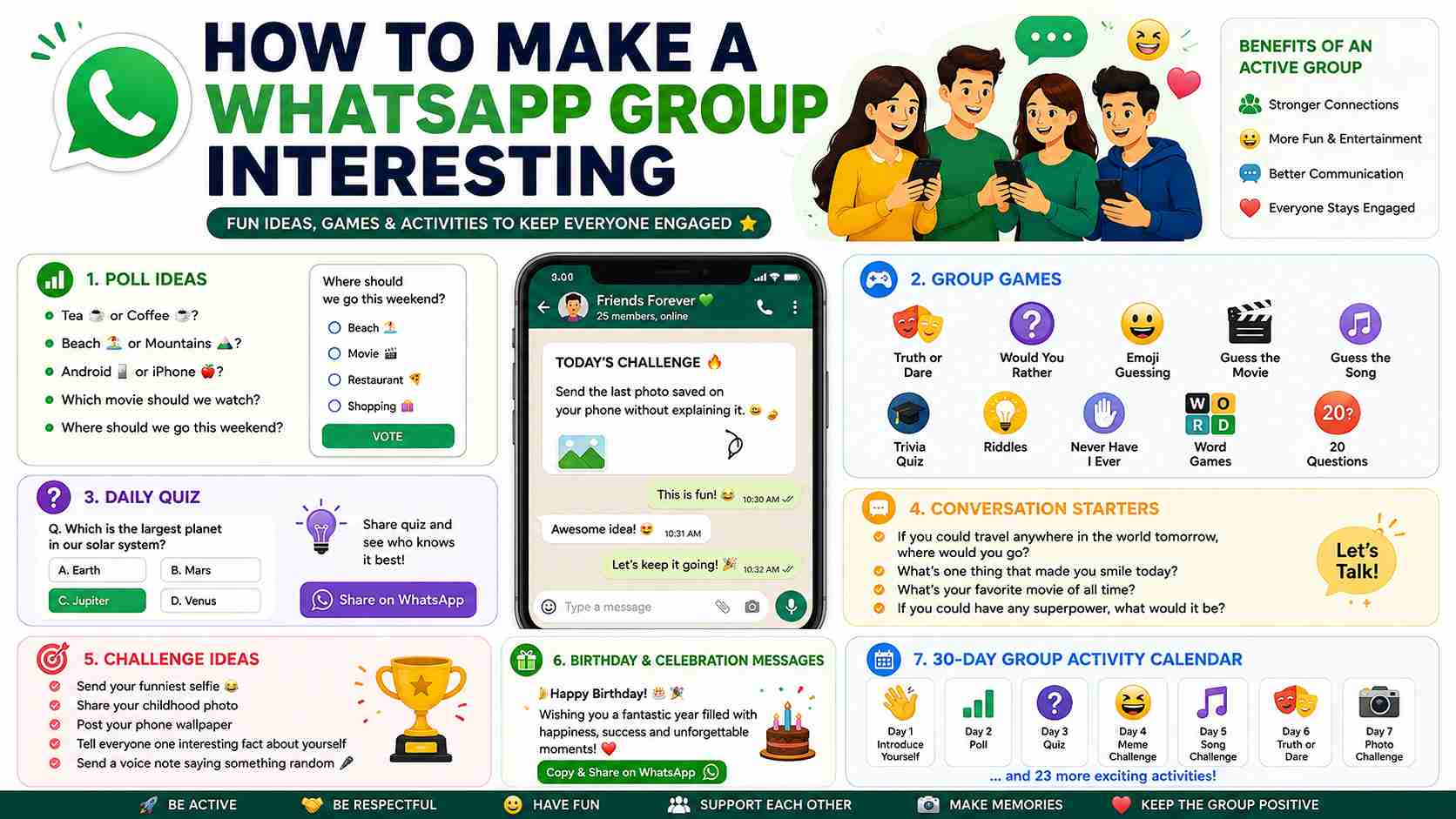
- 2. Use Polls to Get People Talking
- 3. Create Small Group Traditions
- 4. Don’t Rely Only on Text
- 5. Become the Host, Not the Entertainer
- 6. Don’t Turn the Group Into a Notification Machine
- Reduce Forwarded Messages
- 7. Learn When to Stop Talking
- 8. Encourage Reactions Instead of Unnecessary Replies
- 9. Don’t Ignore the Quiet Members
- 10. Handle Arguments Before They Poison the Group
- 11. Try an Occasional “Real” Conversation
- 12. Respect People’s Time
- A Simple WhatsApp Group Engagement Checklist
- Final Thoughts: Build a Community, Not a Notification Feed
You join a WhatsApp group and, for the first few days, your phone barely gets a break. Someone sends a “Good Morning” GIF. Someone else shares a random video. Three people start arguing about where to eat on Friday night. For a brief moment, the group feels alive.
Then it happens.
Silence.
Maybe there are a few forwarded messages every now and then. A political meme appears. Someone sends an old “important warning” that has been circulating for years. But nobody really talks anymore.
Eventually, most people mute the group.
It’s not necessarily because they dislike the people in it. The problem is that the group has stopped giving them a reason to open it.
This is closely connected to notification fatigue. When your phone constantly interrupts you with messages that aren’t useful, funny, personal, or relevant, your brain eventually learns a simple trick: ignore the notification.
And once people start ignoring a group, getting the conversation moving again becomes surprisingly difficult.
The good news? A boring WhatsApp group isn’t always a lost cause.
Making a WhatsApp group interesting isn’t about forcing everyone to talk all day. In fact, that usually makes things worse. The goal is to create a space where people actually want to participate.
Whether it’s your family group, college friends, office colleagues, gaming buddies, or a group built around a shared hobby, a few simple changes can make a huge difference.
Why WhatsApp Group Engagement Fades
Before trying to revive a quiet group, it’s worth understanding why people stop talking in the first place.
One major reason is something similar to the bystander effect.
Imagine a group with 100 people.
Someone has an interesting question. They think, “Someone else will answer.”
Another person sees it and thinks exactly the same thing.
Five minutes pass.
Then an hour.
Nobody replies.
The larger the group becomes, the easier it is for everyone to assume that somebody else will start the conversation.
There’s another problem, too: people become busy.
Work, college, family responsibilities, notifications from other apps, social media, and everyday life all compete for attention. If opening your WhatsApp group doesn’t offer anything interesting, useful, funny, or personal, it’s easy to push it down the priority list.
This is where the group administrator—or even an active member—can make a difference.
You don’t have to become a full-time entertainer. You simply need to give the group a little direction.
Think of that person as the host.
A good host doesn’t talk constantly. They simply know how to get people involved.
1. Give the Group a Personality
Let’s start with something surprisingly simple: the group name.
A group called “Family Group” does its job, but it doesn’t exactly create excitement.
Now compare that with something like:
- The Chaos Syndicate
- Sunday Roast Survivors
- The Unpaid Consultants
- Operation Weekend
- Ctrl + Alt + Friends
- The Last Bench Legends
A funny or meaningful name immediately gives the group a personality.
It can be based on an inside joke, a shared memory, a trip, a college incident, or something completely ridiculous that only the members understand.
The point isn’t to create the “perfect” name.
The point is to make the group feel like your group, rather than just another chat sitting in someone’s phone.
Make the Group Picture Part of the Fun
The same idea applies to the group icon.
Instead of keeping the same generic picture forever, change it occasionally.
Use:
- A funny group photo
- A memorable trip picture
- An inside joke
- A terrible old photograph
- A temporary theme for an event
- A ridiculous edited image
You can even change it after something funny happens in the group.
That tiny change can make people notice the group again.
Use the Description Properly
The group description doesn’t have to be boring either.
You could write something like:
“Official headquarters for bad decisions and questionable food choices.”
Or:
“Rule #1: No meetings. Rule #2: Definitely no forwarded messages.”
A little personality goes a long way.
2. Use Polls to Get People Talking
One of the easiest ways to restart a quiet group is with a poll.
Why?
Because answering a poll requires almost no effort.
Typing a full message can feel like work. Tapping an option takes about two seconds.
That’s why polls work particularly well when the group has gone quiet.
And they don’t always need to be serious.
Try questions such as:
For making plans:
- Where should we eat Friday?
- Movie or restaurant?
- Saturday afternoon or Sunday evening?
For arguments that don’t really matter:
- Pineapple on pizza: yes or absolutely not?
- Tea or coffee?
- Android or iPhone?
- Who is the funniest person here?
For completely unnecessary debates:
- Who would survive longest in a zombie apocalypse?
- Who would get lost first on a road trip?
- Which person would become famous first?
The interesting part isn’t necessarily the poll itself.
It’s what happens afterward.
Someone sees an answer they disagree with.
They reply.
Another person joins.
Suddenly, the group has a conversation again.
The poll is simply the spark.
3. Create Small Group Traditions
You don’t need to organize huge events to keep a group active.
Sometimes a tiny recurring tradition works better.
For example, you could introduce a simple weekly theme.
| Day | Theme | What to Post |
|---|---|---|
| Monday | Monday Madness | Share one funny thing that happened recently |
| Tuesday | Trivia Tuesday | Ask a strange or surprising question |
| Wednesday | Small Win | Share one little thing that went well |
| Thursday | Throwback Thursday | Post an old photo or memory |
| Friday | Weekend Vote | Ask everyone what they’re doing |
| Saturday | Movie/Music Pick | Recommend one movie, song, or show |
| Sunday | Photo Dump | Share one ordinary photo from the week |
The important word here is small.
If every activity feels like homework, people will stop participating.
The best group traditions take seconds to join.
Someone posts a question.
Someone else answers.
That’s it.
Over time, those little traditions can become part of the group’s identity.
4. Don’t Rely Only on Text
A WhatsApp conversation doesn’t have to be hundreds of lines of text.
Sometimes a 20-second voice note tells a story better than five paragraphs ever could.
Try mixing things up.
Voice Notes
Use them for:
- Funny stories
- Quick reactions
- Short updates
- Telling a story that would take too long to type
There’s something different about hearing someone’s actual voice. Tone, pauses, laughter, and sarcasm are much harder to communicate through plain text.
Stickers
Every group eventually develops its own sticker language.
Someone makes a funny expression.
Someone saves the picture.
A sticker is created.
Six months later, everyone knows exactly what that sticker means.
Those little inside jokes can become surprisingly powerful.
Short Videos
Quick videos can also make the conversation feel more natural.
You don’t need to produce a polished video. A short clip from a trip, a funny moment, or a quick reaction is often enough.
But don’t overdo it.
If every message is a sticker, GIF, or random video, people eventually stop paying attention.
The goal is variety, not visual overload.
5. Become the Host, Not the Entertainer
If your group goes quiet, don’t sit there waiting for somebody else to fix it.
Start something.
But there’s an important difference between being a host and trying to be the group’s comedian 24/7.
A host creates opportunities for other people to participate.
For example:
Tag someone naturally:
“Hey Rahul, didn’t you say you were trying this last week?”
Ask an unexpected question:
“If you had to move to another country tomorrow, where would you go?”
Bring back an old memory:
“Does anyone remember what happened on our 2022 trip?”
Share something personal:
“I finally finished that project I’ve been complaining about for two months.”
These messages work because they give people something specific to respond to.
A generic:
“Guys, why is everyone silent?”
usually doesn’t.
6. Don’t Turn the Group Into a Notification Machine
There’s a fine line between an active group and an exhausting group.
Nobody wants 87 notifications before breakfast.
If every message is important, funny, interesting, or personal, people will naturally pay attention.
If the group is constantly filled with random forwards, eventually everything becomes background noise.
That’s why quality matters more than quantity.
Reduce Forwarded Messages
Forwarded content isn’t automatically bad.
A genuinely useful article, funny video, or important announcement can be worth sharing.
The problem is endless low-value forwarding.
Especially things like:
- “Forward this to 10 people.”
- Fake warnings
- Old news presented as new
- Chain messages
- Repeated motivational quotes
- Random promotional content
If you’re an admin, you don’t necessarily need to create strict rules.
A friendly reminder is often enough.
For example:
“Let’s keep forwards to a minimum so the useful stuff doesn’t get buried.”
Simple.
No drama required.
7. Learn When to Stop Talking
This might be the most overlooked part of keeping a WhatsApp group interesting.
You don’t need to keep the conversation alive every minute.
A group that is forced to remain active eventually becomes tiring.
Sometimes a conversation naturally ends.
Let it end.
If you’ve sent five messages and nobody has responded, that’s probably a good signal to pause.
Someone may answer later.
Or perhaps the conversation is simply finished.
That’s completely fine.
A healthy group doesn’t have to be noisy all the time.
In fact, one of the best signs of a good group is that it can disappear for a day or two and then suddenly come back to life when somebody has something worth sharing.
Silence isn’t always failure.
Sometimes it’s just breathing room.
8. Encourage Reactions Instead of Unnecessary Replies
Not every message needs a written response.
Someone says:
“Meeting moved to 5 PM.”
You don’t need ten people replying:
“Okay.”
“Fine.”
“Sure.”
“Got it.”
“Okay bro.”
That’s how notification overload starts.
An emoji reaction can communicate the same thing without filling the chat with unnecessary messages.
Use reactions for simple acknowledgements.
Save actual replies for conversations that deserve them.
This keeps the group cleaner and makes meaningful messages easier to notice.
9. Don’t Ignore the Quiet Members
Every group has them.
The person who reads everything but rarely says anything.
It’s tempting to assume they aren’t interested.
That isn’t necessarily true.
Some people simply don’t enjoy jumping into a crowded conversation.
Instead of publicly calling them out with:
“Why are you always silent?”
try something more natural.
For example:
“Hey, you went to that restaurant recently, right? Was it actually good?”
Now you’ve given them a specific question.
It’s much easier to answer.
And sometimes that’s all it takes to bring someone back into the conversation.
10. Handle Arguments Before They Poison the Group
Every active group eventually has a disagreement.
Sometimes it’s something serious.
Sometimes it’s an argument over football, politics, food, or which movie was better.
The problem isn’t disagreement itself.
The problem is when the disagreement changes the entire atmosphere of the group.
If two people are going back and forth for 100 messages, everyone else may simply stop participating.
When things start getting too heated, move the conversation somewhere more appropriate.
A simple:
“Okay, you two need your own debate channel 😂. Let’s keep this group peaceful.”
can sometimes reset the mood without embarrassing anyone.
The goal isn’t to police every disagreement.
It’s to prevent one argument from taking over the entire community.
11. Try an Occasional “Real” Conversation
Fun is important, but a group shouldn’t become nothing more than memes and polls.
Every once in a while, ask something that actually gives people a chance to share.
For example:
- What’s one thing you’re looking forward to this month?
- What’s something you’ve learned recently?
- What was the best part of your week?
- What’s one place you really want to visit?
- What’s something you’re currently working toward?
Don’t force people to answer.
Just create the opportunity.
Sometimes the best conversations happen when someone unexpectedly opens up.
12. Respect People’s Time
An interesting WhatsApp group isn’t one that talks constantly.
It’s one that respects the people inside it.
Late-night spam, hundreds of unnecessary notifications during work hours, and constant tagging can quickly turn a fun group into an annoyance.
You want members to think:
“Oh, there’s a message from this group. Let’s see what it is.”
Not:
“Ugh. This group again.”
That’s a huge difference.
If possible, let the group have quiet periods.
Nobody needs to feel guilty for not replying immediately.
People have jobs, classes, families, errands, and offline lives.
A good digital community leaves room for all of that.
A Simple WhatsApp Group Engagement Checklist
If you’re an admin or one of the more active members, ask yourself:
- ☐ Does our group have a personality?
- ☐ Is the group name actually memorable?
- ☐ Have we used a poll recently?
- ☐ Are we sharing too many forwards?
- ☐ Do members have easy ways to participate?
- ☐ Have we included quieter members?
- ☐ Are conversations respectful?
- ☐ Do we use different types of content?
- ☐ Are we giving people space when the chat naturally slows down?
- ☐ Does the group actually provide something useful, funny, or meaningful?
You don’t need to check every box.
Even improving two or three of these can change the atmosphere.
Final Thoughts: Build a Community, Not a Notification Feed
At the end of the day, WhatsApp is just the tool.
The app doesn’t make a group interesting.
People do.
You can use polls, stickers, videos, voice notes, jokes, photos, questions, and weekly themes, but none of those things matter if the people in the group don’t feel comfortable participating.
That’s the real secret.
Don’t focus entirely on producing more content.
Focus on creating more connection.
Ask better questions.
Bring people into conversations.
Remember old stories.
Celebrate small wins.
Laugh at your own mistakes.
Give people room to disappear for a while without making them feel guilty.
And, perhaps most importantly, stop treating every message like it needs to be sent.
Before posting something, ask yourself:
“Would I actually want to receive this?”
If the answer is yes, send it.
If the answer is no, maybe leave the phone alone.
The best WhatsApp groups aren’t the ones with the most messages. They’re the ones where people occasionally open the chat and think:
“I’m glad I didn’t mute this.”
So give your group a reason to exist.
Give it a little personality.
Keep the noise under control.
And please, for everyone’s sanity, let that “WhatsApp will start charging tomorrow” message die once and for all.
Join the conversation