Free Experience Calculator | Calculate Work Experience in Years & Months
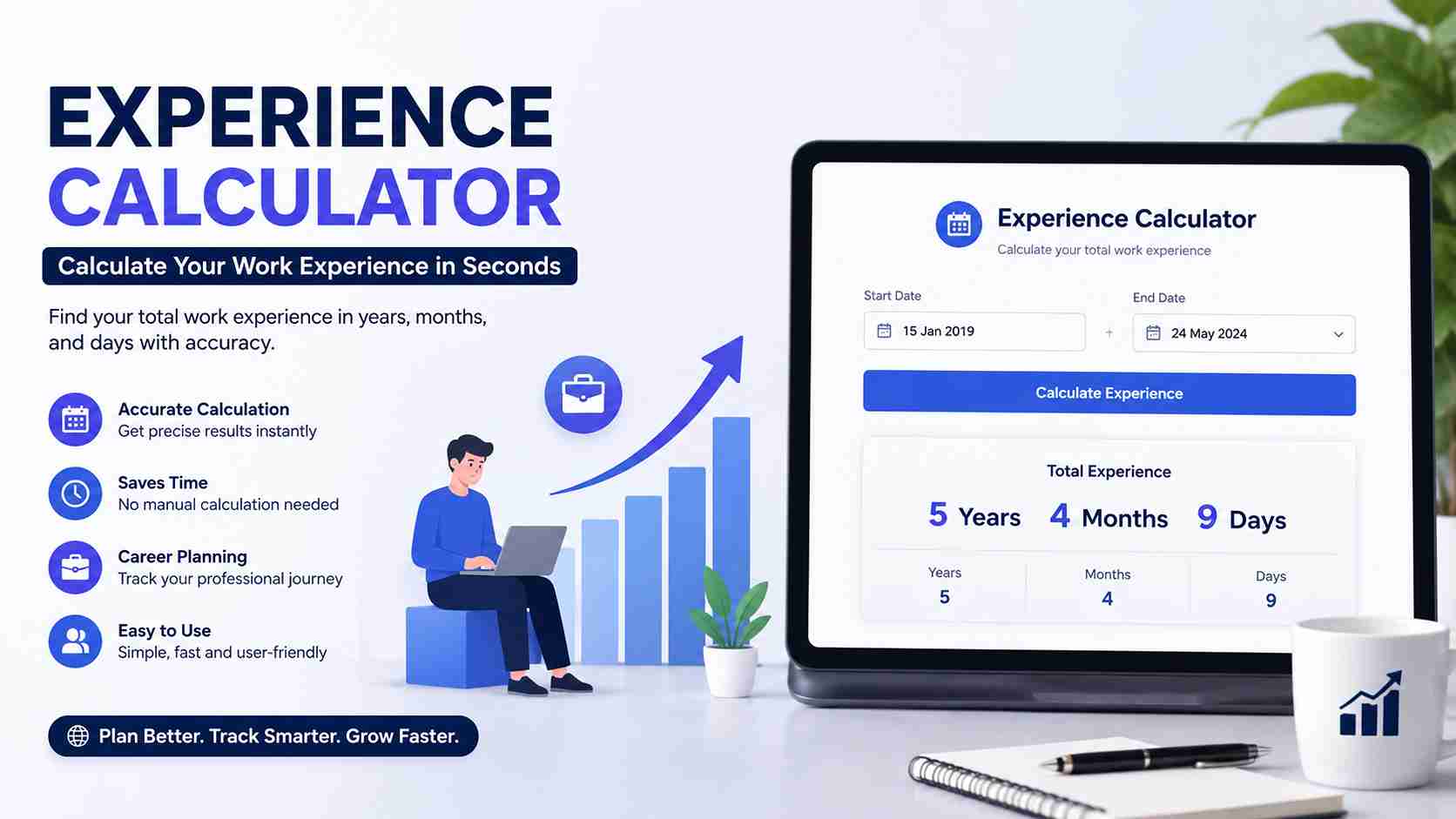
Experience Calculator
Experience calculator
Calendar interval
1. Experience Calculator Online
Place the working calculator immediately near the top.
Contents!
- Experience Calculator
- 1. Experience Calculator Online
- 2. What Is an Experience Calculator?
- 3. How to Calculate Work Experience
- 4. Work Experience Formula
- 5. Calculate Experience in Years, Months and Days
- 6. Calculate Total Work Experience From Multiple Jobs
- 7. Experience Calculator for Resume
- 8. Experience Calculator for Job Applications
- 9. How to Calculate Experience for Current Employment
- 10. Experience Calculator With Multiple Employment Periods
- 11. How Many Years of Experience Do I Have?
- 12. Experience Calculator for Freshers
- 13. Work Experience vs Employment Duration
- 14. Common Experience Calculation Mistakes
- Frequently Asked Questions
Calculator inputs
- Start date
- End date
- Add another employment period
- Calculate
Results
- Total experience
- Years
- Months
- Days
- Total months
- Total days
Also provide a “Present” option so users can calculate their current experience.
2. What Is an Experience Calculator?
Explain that an experience calculator calculates the length of time between employment start and end dates.
Example:
Start: January 15, 2022
End: September 2, 2026
The calculator determines the corresponding years, months and days.
Explain that date-based calculations can differ depending on how an employer or organization counts partial months and days.
3. How to Calculate Work Experience
Give a simple process:
- Enter your joining date.
- Enter your leaving date.
- Select Present if you still work there.
- Click Calculate.
- Review years, months and days.
Then show a worked example.
4. Work Experience Formula
Explain the underlying concept rather than pretending there is one universal formula.
For basic date duration:
End Date − Start Date = Employment Duration
For multiple jobs:
Total Experience = Period 1 + Period 2 + Period 3 + …
Explain that overlapping employment periods should generally not be double-counted when calculating total chronological experience.
5. Calculate Experience in Years, Months and Days
This should be one of the strongest sections.
Example:
Start date: March 10, 2021
End date: September 2, 2026
Explain how the calculator determines the elapsed calendar period.
Also explain why simply doing:
2026 − 2021 = 5 years
is not always sufficient because the exact month and day matter.
6. Calculate Total Work Experience From Multiple Jobs
This is an excellent differentiating feature for IOIVD.
Example:
| Job | Start | End |
|---|---|---|
| Company A | Jan 2020 | Jun 2021 |
| Company B | Aug 2021 | Dec 2023 |
| Company C | Feb 2024 | Present |
The calculator can calculate each period and then combine them.
Important
If two employment periods overlap, explain that users should avoid counting the overlapping period twice.
7. Experience Calculator for Resume
Explain how candidates can use the calculator when preparing a resume.
Example:
Instead of writing:
Work experience: approximately 4 years
they can determine their actual employment duration and then present it appropriately.
Also explain that a resume should follow the conventions requested by the employer rather than blindly copying calculator output.
8. Experience Calculator for Job Applications
Cover situations where applications ask:
- Total years of experience
- Relevant experience
- Professional experience
- Experience in a specific technology
- Experience in a specific role
Important distinction
Total experience ≠ relevant experience
Example:
Someone may have 5 years of total employment experience but only 3 years working specifically in software development.
That’s a useful, genuinely informative distinction.
9. How to Calculate Experience for Current Employment
Explain how to calculate experience when someone is still working.
Example:
Joining date: June 15, 2023
End date: Present
The calculator uses the current date as the end date.
Include a clear note:
Your result changes automatically as time passes.
10. Experience Calculator With Multiple Employment Periods
Add a detailed example:
| Employer | Duration |
|---|---|
| Company A | 1 year 8 months |
| Company B | 2 years 3 months |
| Company C | 1 year 2 months |
Then explain how the durations can be combined and why exact date calculations are preferable to manually adding rounded values.
11. How Many Years of Experience Do I Have?
Answer the search intent directly.
Tell users to enter:
Joining date → Leaving date
or:
Joining date → Present
Then use the calculator.
This section can target the long-tail keyword:
“how many years of work experience do I have”
12. Experience Calculator for Freshers
Explain that a fresher generally has no prior professional employment experience, but internships, apprenticeships, projects and freelance work may be treated differently depending on the job application.
Don’t tell users to falsely classify internships as full-time employment.
13. Work Experience vs Employment Duration
Explain the difference.
Employment duration:
How long someone was employed during a specific period.
Work experience:
A broader term that may include relevant professional experience, depending on the context.
This distinction is particularly useful for job applications.
14. Common Experience Calculation Mistakes
Include:
- Entering the wrong joining date.
- Using today’s date manually instead of selecting Present.
- Counting overlapping jobs twice.
- Rounding 11 months up to one year.
- Confusing internship experience with professional experience.
- Reporting total experience when an application asks for relevant experience.
- Ignoring gaps between jobs.
Frequently Asked Questions
What is an experience calculator?
An experience calculator is an online tool that calculates the length of time between two dates. It can show work experience in years, months, and days. It is useful for checking employment duration, preparing a resume, and completing job applications.
How do I calculate my work experience?
Enter your employment start date and end date into the experience calculator. If you are still working at the company, select the Present option. The calculator will determine the elapsed time between the dates and display your experience in years, months, and days.
Can I calculate experience in years and months?
Yes. An experience calculator can calculate employment duration using years, months, and days. This is more precise than simply subtracting the starting year from the ending year because the exact month and day also affect the result.
Can I calculate experience for my current job?
Yes. If you are currently employed, enter your joining date and select Present as the end date. The calculator can then calculate your experience up to the current date.
Can I add multiple jobs?
Yes. If the calculator supports multiple employment periods, you can enter each job separately and calculate your total experience. This is useful when you have worked for several companies or organizations.
Does the calculator count overlapping employment?
The calculator may calculate each employment period separately, but overlapping periods should not normally be counted twice when determining total chronological work experience. If two jobs overlap, review the dates carefully and follow the method required by the employer or organization.
Can I use this calculator for a resume?
Yes. You can use an experience calculator to check the duration of your previous employment before adding it to your resume. However, always report your experience accurately and follow the employer’s instructions about how experience should be presented.
How is work experience calculated for job applications?
Work experience is generally determined from the relevant employment dates. However, job applications may define experience differently. For example, an employer may ask specifically for total experience, relevant experience, or experience in a particular role or technology. Always follow the definition provided in the application.
Does internship experience count as work experience?
It depends on the employer, job application, or organization. Some employers may consider relevant internships, apprenticeships, or paid training as experience, while others may count only professional employment. If an application specifically asks for full-time professional experience, do not automatically include internships unless the instructions allow it.
Is one year of experience exactly 12 months?
For many practical purposes, one year is treated as 12 months. However, exact employment duration is calculated using calendar dates, so the number of days can also matter. For example, employment from January 10, 2025 to January 10, 2026 represents one full year, while January 10, 2025 to January 9, 2026 is slightly less than one year.
Join the conversation