Free Cubic Yard Calculator | Calculate Cubic Yards, Feet & Meters
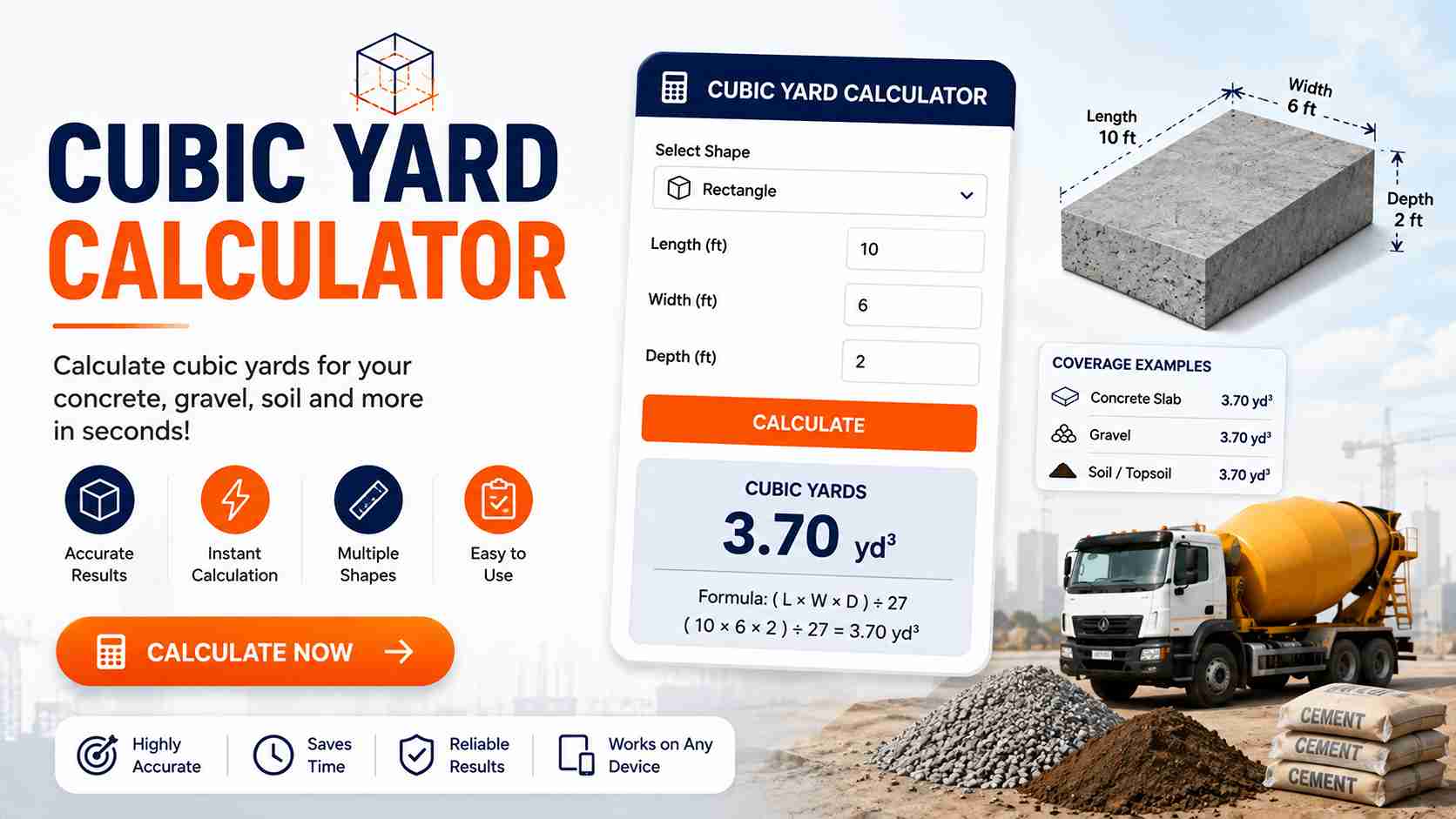
Cubic Yard Calculator: Calculate Cubic Yards, Cubic Feet & Cubic Meters
Calculating how much soil, mulch, gravel, sand, concrete, or another bulk material you need can be surprisingly difficult when your measurements are in feet and inches but the supplier sells material by the cubic yard.
Contents!
- Cubic Yard Calculator: Calculate Cubic Yards, Cubic Feet & Cubic Meters
- Cubic Yard Calculator
- What Is a Cubic Yard?
- How to Calculate Cubic Yards
- Cubic Yard Formula
- How to Calculate Cubic Yards When Depth Is in Inches
- Cubic Feet to Cubic Yards
- Cubic Yards to Cubic Meters
- Cubic Yard Calculator for Soil
- Cubic Yard Calculator for Mulch
- Cubic Yard Calculator for Gravel
- Cubic Yard Calculator for Concrete
- Cubic Yard Calculator for a Trench
- How Many Cubic Feet Are in a Cubic Yard?
- How Many Cubic Yards Do I Need?
- Cubic Yard Conversion Table
- How Accurate Is a Cubic Yard Calculator?
- Common Mistakes When Calculating Cubic Yards
- How to Calculate an Irregular Area
- Should You Add Extra Material?
- Frequently Asked Questions
- Final Thoughts
The Cubic Yard Calculator makes this calculation easier. Enter the length, width, and depth of your project, and you can determine the approximate volume in cubic yards. You can also use the result to understand the equivalent volume in cubic feet or cubic meters.
Whether you are preparing a garden bed, filling a trench, spreading mulch, adding topsoil, installing gravel, or estimating concrete volume, knowing the cubic yardage can help you order the right amount of material.
Cubic Yard Calculator
Use the calculator above to enter your project dimensions.
For a rectangular or square area, the basic calculation is:
Cubic Yards = Length × Width × Depth ÷ 27
The measurements need to be converted to feet before using this formula.
For example, suppose an area is:
- Length: 20 feet
- Width: 10 feet
- Depth: 4 inches
First convert the depth from inches to feet:
4 ÷ 12 = 0.3333 feet
Then calculate the volume:
20 × 10 × 0.3333 = 66.67 cubic feet
Finally:
66.67 ÷ 27 = 2.47 cubic yards
So the project requires approximately 2.47 cubic yards of material before considering any additional allowance for waste, settling, uneven surfaces, or measurement uncertainty.
What Is a Cubic Yard?
A cubic yard is a unit of volume commonly used in the United States for measuring bulk materials such as soil, mulch, gravel, sand, and concrete.
One cubic yard is a cube that measures:
3 feet × 3 feet × 3 feet
Therefore:
1 cubic yard = 27 cubic feet
The conversion is exact because:
3 × 3 × 3 = 27
So:
- 1 cubic yard = 27 cubic feet
- 2 cubic yards = 54 cubic feet
- 3 cubic yards = 81 cubic feet
- 5 cubic yards = 135 cubic feet
- 10 cubic yards = 270 cubic feet
This conversion is useful because project dimensions are often measured in feet, while landscape suppliers commonly sell bulk material by cubic yards.
How to Calculate Cubic Yards
For a rectangular area, use three measurements:
- Length
- Width
- Depth
The formula is:
Cubic Yards = Length × Width × Depth ÷ 27
The important part is making sure all measurements use the same unit.
Step 1: Measure the length
Measure the longest dimension of the area in feet.
Step 2: Measure the width
Measure the width of the area in feet.
Step 3: Measure the depth
Measure the required material depth.
Depth is frequently measured in inches, especially for mulch, soil, gravel, and similar materials.
If the depth is in inches, divide it by 12 to convert it to feet.
Step 4: Calculate cubic feet
Multiply:
Length × Width × Depth
Step 5: Convert cubic feet to cubic yards
Divide the cubic-foot result by 27.
Cubic Yard Formula
The standard formula for a rectangular area is:
Cubic Yards = L × W × D ÷ 27
where:
- L = length in feet
- W = width in feet
- D = depth in feet
For example:
15 ft × 12 ft × 0.5 ft ÷ 27
= 90 ÷ 27
= 3.33 cubic yards
So an area measuring 15 feet by 12 feet with a depth of 6 inches requires approximately 3.33 cubic yards.
How to Calculate Cubic Yards When Depth Is in Inches
This is one of the most common situations.
Suppose your project measures:
- Length = 30 ft
- Width = 15 ft
- Depth = 6 inches
Convert 6 inches to feet:
6 ÷ 12 = 0.5 ft
Then:
30 × 15 × 0.5 = 225 cubic feet
Convert cubic feet to cubic yards:
225 ÷ 27 = 8.33 cubic yards
Therefore, the calculated volume is approximately:
8.33 cubic yards
You can also combine the conversion into one formula:
Cubic Yards = Length × Width × Depth in inches ÷ 324
The number 324 comes from 12 × 27.
Cubic Feet to Cubic Yards
If you already know the volume in cubic feet, conversion is simple:
Cubic Yards = Cubic Feet ÷ 27
For example:
100 cubic feet ÷ 27 = 3.70 cubic yards
Therefore:
100 ft³ ≈ 3.70 yd³
To convert in the opposite direction:
Cubic Feet = Cubic Yards × 27
For example:
4 cubic yards × 27 = 108 cubic feet
A cubic yard contains exactly 27 cubic feet.
Cubic Yards to Cubic Meters
You may also need to convert between U.S. customary units and metric units.
One cubic yard is approximately:
0.7646 cubic meters
Therefore:
Cubic Meters = Cubic Yards × 0.7646
For example:
5 cubic yards × 0.7646 ≈ 3.82 cubic meters
For a more accurate calculation, use the calculator’s metric conversion rather than manually rounding intermediate values.
Cubic Yard Calculator for Soil
A cubic yard calculator is useful when ordering topsoil for:
- Raised garden beds
- Lawn preparation
- Flower beds
- Vegetable gardens
- Landscaping projects
- Filling low areas
Measure the length and width of the area and determine the desired soil depth.
For example, if a garden bed is 12 feet long, 8 feet wide, and needs 6 inches of soil:
12 × 8 × 0.5 = 48 cubic feet
Then:
48 ÷ 27 = 1.78 cubic yards
The calculated volume is approximately 1.78 cubic yards.
Because soil can settle after placement, the amount actually ordered may need to be somewhat different depending on the project and the supplier’s recommendations.
Cubic Yard Calculator for Mulch
Mulch is commonly purchased by the cubic yard.
To estimate the required amount, measure:
Length × Width × Desired Depth
For example:
- Length = 20 ft
- Width = 15 ft
- Depth = 3 inches
Convert the depth:
3 ÷ 12 = 0.25 ft
Then:
20 × 15 × 0.25 = 75 cubic feet
Convert to cubic yards:
75 ÷ 27 = 2.78 cubic yards
So the calculated requirement is approximately 2.78 cubic yards.
When ordering, consider the actual depth you want after the mulch has been spread and settled.
Cubic Yard Calculator for Gravel
The same basic volume calculation can be used for gravel.
For example, imagine a driveway section that is:
- 40 feet long
- 10 feet wide
- 4 inches deep
Convert the depth:
4 ÷ 12 = 0.3333 ft
Calculate:
40 × 10 × 0.3333 = 133.33 cubic feet
Then:
133.33 ÷ 27 ≈ 4.94 cubic yards
The calculated volume is approximately 4.94 cubic yards.
Gravel is sometimes sold by weight rather than volume, so if your supplier quotes prices in tons, you may need a separate weight conversion based on the specific type and density of gravel.
Cubic Yard Calculator for Concrete
Concrete volume can also be estimated using cubic yards.
For a rectangular slab:
Length × Width × Depth ÷ 27
Suppose a slab is:
- 20 ft long
- 10 ft wide
- 4 inches thick
Then:
20 × 10 × 0.3333 ÷ 27 ≈ 2.47 cubic yards
This is the mathematical volume.
For an actual concrete order, however, project conditions, irregular edges, grade variations, waste, and supplier practices can affect the amount required. For structural work, use project specifications and confirm the quantity with the concrete supplier or a qualified professional.
Cubic Yard Calculator for a Trench
A trench can often be treated as a rectangular volume.
For example:
- Length = 50 ft
- Width = 2 ft
- Depth = 1.5 ft
Calculate:
50 × 2 × 1.5 = 150 cubic feet
Then:
150 ÷ 27 = 5.56 cubic yards
Therefore, the theoretical volume is approximately 5.56 cubic yards.
If the trench has sloped sides or an irregular cross-section, a simple rectangular calculation may not accurately represent the actual volume.
How Many Cubic Feet Are in a Cubic Yard?
There are exactly:
27 cubic feet in 1 cubic yard.
This is because one yard is three feet:
3 × 3 × 3 = 27
The relationship is:
1 yd³ = 27 ft³
and:
1 ft³ = 0.037037 yd³
For quick calculations, remember:
Multiply by 27 to convert cubic yards to cubic feet.
Divide by 27 to convert cubic feet to cubic yards.
How Many Cubic Yards Do I Need?
The answer depends on three things:
Area × depth × unit conversion
For a rectangular project:
Cubic Yards = Length × Width × Depth ÷ 27
If your depth is measured in inches:
Cubic Yards = Length × Width × Depth ÷ 324
For example, a 10 × 20 foot area at 3 inches deep:
10 × 20 × 3 ÷ 324 = 1.85 cubic yards
So the mathematical requirement is approximately 1.85 cubic yards.
Cubic Yard Conversion Table
| Cubic Yards | Cubic Feet | Approx. Cubic Meters |
|---|---|---|
| 0.5 | 13.5 | 0.38 |
| 1 | 27 | 0.76 |
| 2 | 54 | 1.53 |
| 3 | 81 | 2.29 |
| 4 | 108 | 3.06 |
| 5 | 135 | 3.82 |
| 10 | 270 | 7.65 |
The cubic-foot conversion uses the exact relationship of 27 cubic feet per cubic yard; metric values are rounded for display.
How Accurate Is a Cubic Yard Calculator?
A calculator can accurately determine the mathematical volume when the measurements entered are accurate.
However, the amount of material you should purchase can be different from the theoretical volume.
Real projects can involve:
- Uneven ground
- Sloped surfaces
- Irregular shapes
- Material settling
- Compaction
- Spillage
- Cutting or trimming losses
- Variations in delivery quantities
For this reason, treat the calculator result as an estimate of volume, not a guarantee of the exact amount a supplier will recommend.
For important construction projects, verify your measurements and order quantity with the relevant supplier or professional.
Common Mistakes When Calculating Cubic Yards
1. Forgetting to convert inches to feet
A depth of 4 inches is not 4 feet.
You need:
4 ÷ 12 = 0.3333 feet
2. Dividing by 27 too early
First calculate the volume in cubic feet, then divide by 27.
3. Mixing units
Don’t use length in feet, width in yards, and depth in inches without converting them.
4. Measuring an irregular area as a perfect rectangle
For irregular areas, divide the project into smaller sections and calculate each section separately.
5. Confusing cubic feet with square feet
Square feet measure area.
Cubic feet measure volume.
Depth is required when calculating cubic volume.
6. Assuming every material has the same weight
One cubic yard of mulch, gravel, soil, and concrete does not weigh the same.
Volume and weight are different measurements.
How to Calculate an Irregular Area
If your project isn’t a simple rectangle, divide it into smaller shapes.
For example, an L-shaped garden can be separated into two rectangles.
Calculate:
Area 1 volume + Area 2 volume = Total volume
Then convert the total cubic feet to cubic yards.
This approach is usually easier and more reliable than trying to force an irregular area into one rectangular measurement.
Should You Add Extra Material?
The calculator gives you the mathematical volume based on the measurements you enter.
The quantity you purchase may need an additional allowance depending on the project.
Possible reasons include:
- Uneven surfaces
- Material settling
- Compaction
- Small measurement errors
- Waste during installation
There isn’t one universal percentage that is appropriate for every material or project.
For significant purchases, ask your supplier whether they recommend an additional amount.
Frequently Asked Questions
What is a Cubic Yard Calculator?
A Cubic Yard Calculator helps you calculate the volume of soil, mulch, gravel, sand, concrete, or other materials needed for a project. Enter the length, width, and depth of the area to estimate the required cubic yards.
How do I calculate cubic yards?
To calculate cubic yards, multiply the length, width, and depth in feet, then divide the result by 27. The formula is: Cubic Yards = Length × Width × Depth ÷ 27.
How many cubic feet are in one cubic yard?
One cubic yard contains 27 cubic feet. To convert cubic feet to cubic yards, divide the cubic-foot measurement by 27.
How do I calculate cubic yards when the depth is in inches?
If the length and width are in feet and the depth is in inches, multiply length × width × depth in inches, then divide by 324. This converts the measurement into cubic yards.
Can I use a cubic yard calculator for soil, mulch, and gravel?
Yes. A cubic yard calculator can estimate the volume of soil, mulch, gravel, sand, concrete, and similar bulk materials. The amount you should order may vary depending on material settling, compaction, moisture, and project conditions.
How accurate is a cubic yard calculation?
The calculation is mathematically accurate when your measurements are accurate. For real projects, consider the shape of the area, uneven depth, compaction, and material loss when deciding how much material to order.
Final Thoughts
Calculating cubic yards doesn’t have to be complicated.
For a rectangular project, remember the basic formula:
Cubic Yards = Length × Width × Depth ÷ 27
If the depth is in inches:
Cubic Yards = Length × Width × Depth ÷ 324
The IOIVD Cubic Yard Calculator can save time by performing these conversions for you and showing the resulting volume in useful units.
For landscaping, gardening, excavation, gravel, mulch, soil, sand, and other projects, always measure carefully and consider the actual characteristics of the material and site. The calculator provides a mathematical volume estimate; your supplier or project professional can help determine the appropriate amount to order for the specific job.
Join the conversation