How to Calculate CGPA in 10 Seconds | Quick Formula + Chart
Introduction
There’s this oddly familiar moment every student faces… how to calculate CGPA.
You open your report card, glance at a bunch of grades, and suddenly a small question starts poking your brain:
“Okay… but what’s my CGPA?”
It happened to me, too.
Back in college, right after an exam season that felt like running a marathon with a backpack full of bricks, the results came. My friend Rahul whispered, “Bro, how do we calculate CGPA again? I swear they make this intentionally confusing.”
And honestly? It does feel like they do.
But you and I are going to break it down slowly, like two friends solving a puzzle over a cup of chai.
No jargon bombs. No robotic textbook tone. Just clarity.
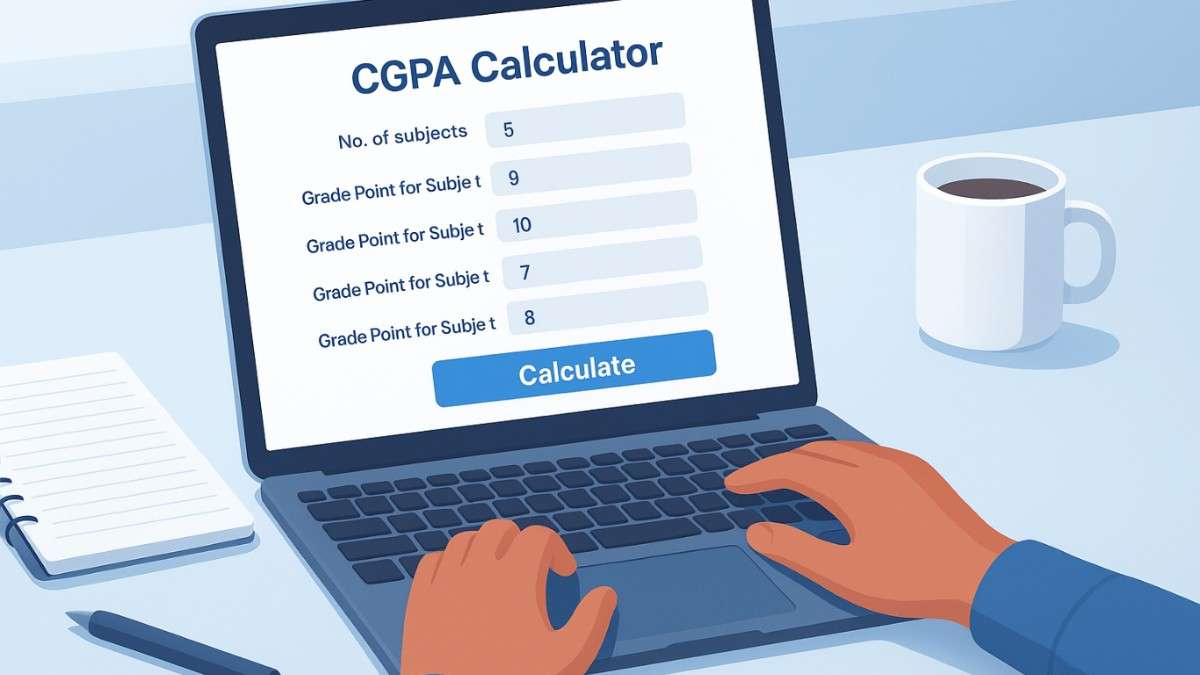
CGPA Calculator
CGPA Calculator
Table of Contents
What Exactly Is CGPA?
- CGPA stands for Cumulative Grade Point Average, which is just a fancy academic way of saying:
- “Your overall performance, but in numbers.”
- Instead of calculating every single mark again and again, institutions convert grades to points. Then they average these points to get your CGPA.
- It’s basically like averaging your moods over a year; some days are 10/10, some days are 5/10, but overall, you get a vibe of how life went.
- Easy enough?
How to Calculate CGPA: The Formula That Actually Makes Sense
Here’s the simple truth:
CGPA = (Total Grade Points in All Subjects) ÷ (Total Subjects)
- That’s it.
- Nothing scary. Nothing hidden.
- Let’s walk through it like a real human would.
Step-by-Step: How Do We Calculate CGPA?
Let’s pretend you’re a student with five subjects.
Your report card gives you grade points like this:
| Subject | Grade Point (GP) |
| Math | 9 |
| English | 8 |
| Science | 10 |
| Social | 7 |
| Hindi | 8 |
Now:
- Add them up → 9 + 8 + 10 + 7 + 8 = 42
- Divide by number of subjects → 42 ÷ 5 = 8.4
Your CGPA = 8.4
Suddenly, it doesn’t feel that complicated, right?
But Wait… Universities Use GPA Too. So, How Do You Calculate CGPA From GPA?
This question hits every student at some point.
GPA = Grade Point Average of ONE semester
CGPA = Cumulative GPA of ALL semesters
Imagine each semester is like an episode of your academic season.
CGPA? That’s the full-season rating.
Formula to Calculate CGPA From GPA:
CGPA = (Total GPA of All Semesters) ÷ (Number of Semesters)
Example:
Let’s say your 4-semester GPAs look like this:
- Sem 1 → 7.5
- Sem 2 → 8.2
- Sem 3 → 8.0
- Sem 4 → 7.8
Add them:
7.5 + 8.2 + 8.0 + 7.8 = 31.5
Now divide by 4:
31.5 ÷ 4 = 7.87
Your CGPA = 7.87
It’s basically averaging your semester “scores.”
How to Calculate a CGPA When Credits Are Involved
Some universities, especially engineering, medical, and foreign institutions, use a credit-based system.
Here, each subject carries a weight.
Think of credits like:
- Maths (4 credits) is heavier
- Physical Education (1 credit) is lighter
So the calculation changes slightly.
Weighted CGPA Formula:
CGPA = (Σ (Grade Point × Credits)) ÷ (Σ Credits)
Let’s warm it up with a realistic example.
Example of CGPA Calculation with Credits
Subject Grade Point Credits
| Subject | Grade Point | Credits |
| Math | 9 | 4 |
| Physics | 8 | 3 |
| English | 7 | 2 |
| CS | 10 | 3 |
Step 1: Multiply GP × Credits
- Math = 9 × 4 = 36
- Physics = 8 × 3 = 24
- English = 7 × 2 = 14
- CS = 10 × 3 = 30
Sum → 36 + 24 + 14 + 30 = 104
Step 2: Add all credits
4 + 3 + 2 + 3 = 12
Step 3: Divide
104 ÷ 12 = 8.66
Your CGPA = 8.66
Pretty neat, right?
Why Do Students Find CGPA Confusing?
Because different boards, colleges, and countries use different scales:
- Some use 10-point
- Some use 4-point
- Some use letter grades
- Some use percentages
- Some mix everything like a fruit salad, then blame you for being confused
Honestly? Students are heroes for figuring this out every year without losing their minds.
Converting CGPA to Percentage
Most Indian boards use:
Percentage = CGPA × 9.5
So if your CGPA is 8.4:
8.4 × 9.5 = 79.8%
But here’s the twist:
Different universities have different formulas, so check your official handbook. They love changing rules like it’s a hobby.
Common Questions Students Whisper
1. “What’s a good CGPA?”
Depends on the institution, but:
- 8.0+ is considered strong
- 9.0+ is excellent
- 7.0+ is decent and respectable
And honestly, life won’t end if you score 6.5.
Your skills will save you more than your CGPA ever will.
2. “Is CGPA more important than GPA?”
- CGPA reflects your overall academic journey.
- GPA is just for one semester.
- Think of GPA as a single cricket match score.
- CGPA is your average across the whole tournament.
3. “Can I improve my CGPA later?”
Absolutely.
Even one semester of great grades can pull up your overall CGPA like a hero lifting the story in the final scene.
Practical Tips to Improve Your CGPA
Tip 1: Study smart, not long
Even three focused hours can beat 10 distracted ones.
Tip 2: Pick scoring subjects strategically
Some subjects give higher grade points with less effort. Use them wisely.
Tip 3: Keep track of credits
High-credit subjects influence CGPA more than low-credit ones.
Tip 4: Don’t fear internal marks
They add up faster than you think.
Tip 5: Never underestimate revision
A single revision can turn a B+ into an A.
A Small Story Before We Wrap Up
- There was a girl in my class, Ananya.
- Super calm, never stressed, the kind who finishes her notes before the teacher even starts.
- Her CGPA?
- A perfect 9.6.
- But here’s the fun part:
- When someone asked for her “secret,” she shrugged and said,
- “I just understand the logic. Marks come automatically.”
- And honestly? That’s the truth.
- If you understand the concept, CGPA will follow you like a loyal puppy.
Final
- Knowing how to calculate CGPA shouldn’t feel like decoding an alien language.
- Once you understand grade points, GPAs, credits, and the simple formulas, everything falls into place like puzzle pieces finally cooperating.
- Take a breath.
- You’re doing great.
- Numbers can feel scary, but they’re just numbers.
- And now you know exactly how to handle them.